Bowling Terminology
At a Glance
This comprehensive glossary provides definitive explanations of tournament structures, scoring formats, and lane oil conditions. These terms govern competitive bowling environments and dictate both strategic lane play and event organization.
Tournament Types & Formats
Mixed Doubles: A tournament format where teams are comprised of exactly two bowlers, typically one male and one female.
Baker Match: A team format where multiple bowlers combine to play a single game. Instead of each person bowling their own individual game, players alternate frames in a set lineup sequence (e.g., Bowler 1 plays frames 1 and 6, Bowler 2 plays frames 2 and 7) to complete the 10-frame game collectively.
Match Play: A competitive elimination or round-robin format where bowlers compete directly head-to-head against an opponent in a game or block of games. The winner of the match is awarded bonus points or advances in the bracket, regardless of their total pinfall relative to the rest of the field.
No-Tap Tournament: A modified format designed to boost scoring potential where knocking down a specific number of pins (most commonly 9 pins) on the first delivery is automatically scored as a strike.
Scratch Format: A pure competitive format utilizing raw scores only. No handicap points are added, ensuring that standings are determined strictly by total raw pinfall.
Handicap Format: A balanced competitive format where additional points (a handicap) are added to a bowler's score based on a predetermined percentage formula (e.g., 80% of 220). This equalizes the playing field across different entering averages and skill levels.
Oil Pattern Categories & Classifications
Oil Patterns: The specific distribution and volume of protective lane conditioner applied across the synthetic or wood lane surface. Patterns vary by length, shape, and volume, directly affecting ball friction, hook potential, and overall lane transition.
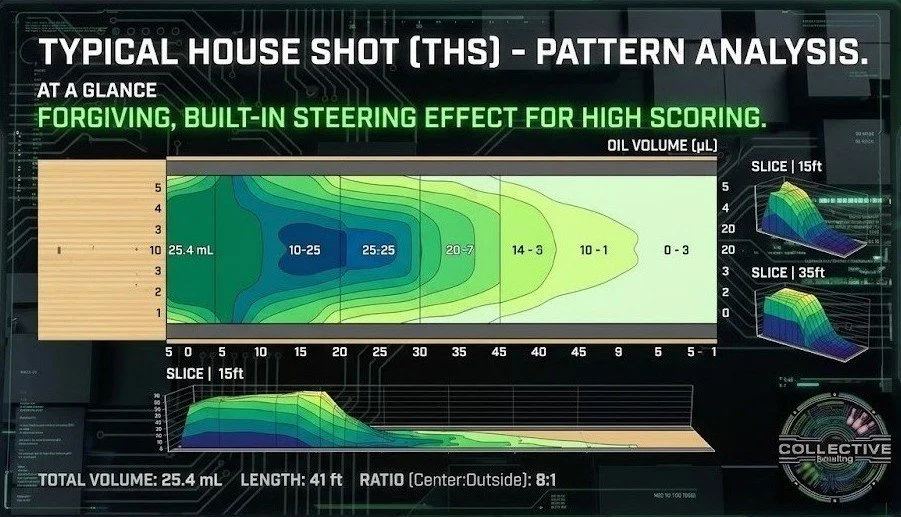
House Pattern (THS - Typical House Shot): A forgiving, recreational oil pattern applied by most bowling centers for league play. It features a heavy concentration of oil in the center of the lane and significantly less oil on the outside boards, creating a built-in steering effect that guides off-target shots back toward the pocket.
Sport Oil Patterns: A highly challenging, flat oil pattern used in professional and advanced competition. The ratio of oil in the center of the lane compared to the outside boards is very low (typically 3:1 or less), providing minimal margin for error and requiring extreme accuracy and precise lane play adjustments.
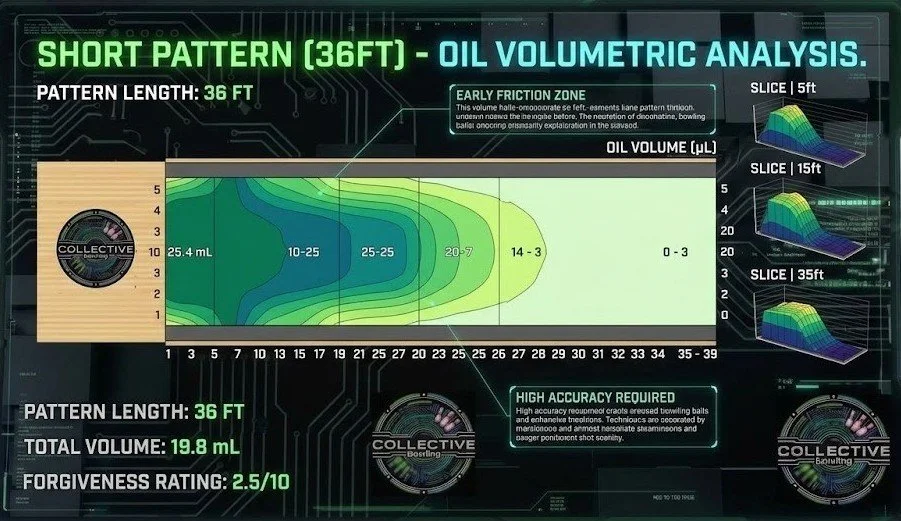
Short Pattern: An oil pattern measuring under 37 feet in total length. Because the oil ends early, bowling balls encounter friction quickly, causing them to hook much earlier down the lane and requiring bowlers to use smoother equipment or play extreme outside angles.
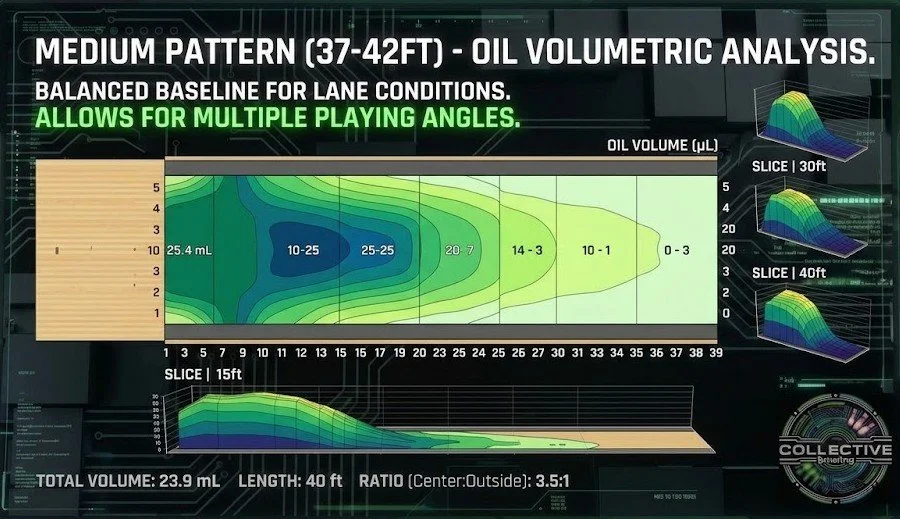
Medium Pattern: An oil pattern measuring between 37 and 42 feet in length. This represents the standard baseline for lane conditions, offering a balanced mix of front-lane skid and down-lane friction that allows for multiple playing angles.
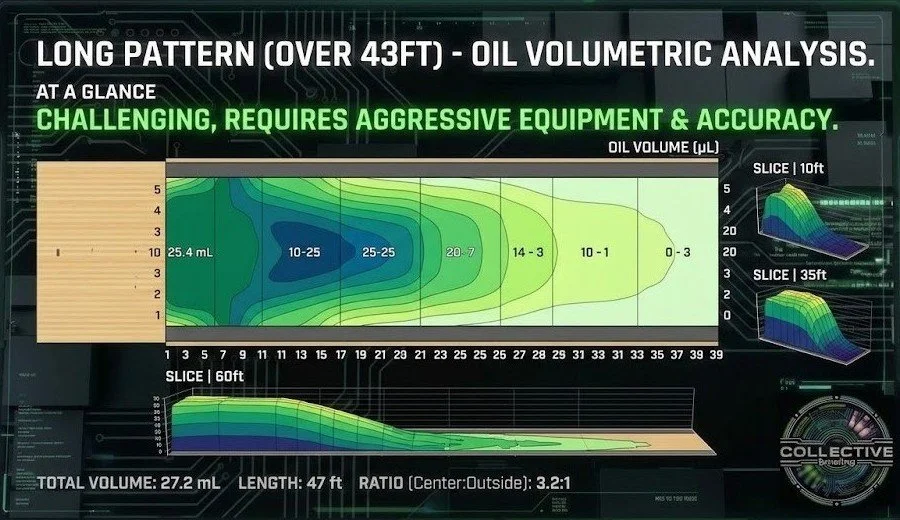
Long Pattern: An oil pattern measuring 43 feet or more in length. Because the oil extends far down the lane, the ball skids longer and has a delayed reaction, requiring highly aggressive equipment, slower ball speeds, or tight, direct angles to successfully hit the pocket.